
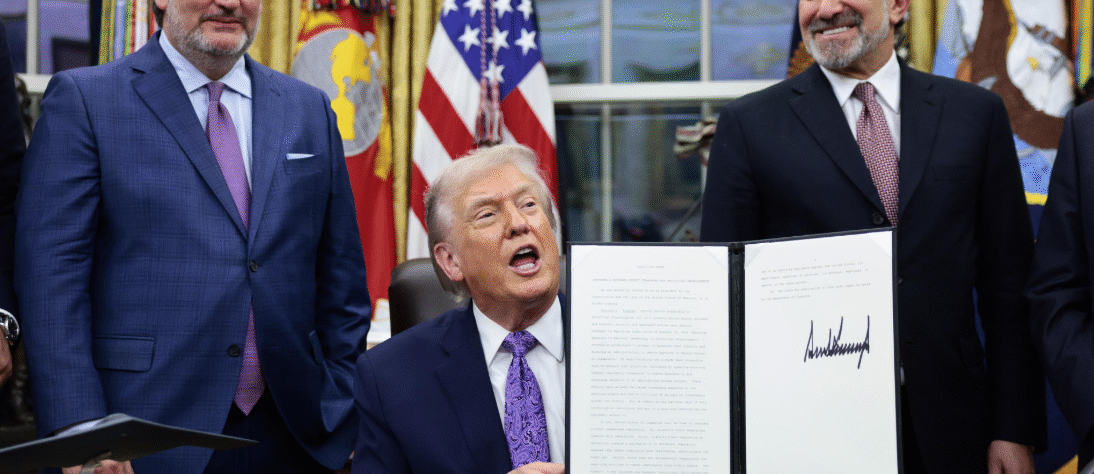
President Donald Trump signed an executive order aimed at preventing individual states from enforcing their own artificial intelligence regulations, instead directing federal authorities to develop a single national framework for AI governance. The move signals a major federal intervention in the rapidly expanding AI sector.
Speaking in the Oval Office, White House aide Will Scharf explained that the order directs aspects of the administration to ensure AI operates under one national framework, rather than facing potentially conflicting state-level rules that could hinder innovation. The executive order (EO) is intended to streamline AI regulation and maintain U.S. competitiveness in the global AI race.
Federal Framework for AI
David Sacks, the White House’s crypto and AI czar, stated that the EO will guide the creation of a federal framework in collaboration with Congress. “In the meantime, this EO provides the administration with tools to push back against the most excessive state regulations,” Sacks said during the signing ceremony. He emphasized that the EO does not interfere with state-level protections for child safety, clarifying later on social media that the administration will not challenge all state AI laws.
The order comes after Congress rejected earlier efforts to restrict states from regulating AI. In July, Republicans sought a 10-year moratorium on state AI regulations as part of a domestic policy bill, but the Senate voted overwhelmingly to remove it. Similarly, proposals to include an AI moratorium in the National Defense Authorization Act were declined.
Industry and Innovation Implications
Tech leaders in Silicon Valley, including OpenAI CEO Sam Altman, have long warned that a patchwork of state regulations could slow innovation and undermine U.S. competitiveness against China, potentially affecting both the economy and national security. A unified federal framework, proponents argue, would provide clarity for companies and foster faster development of AI tools.
However, critics caution that limiting state oversight could reduce accountability for AI companies, particularly if their systems cause harm. Artificial intelligence increasingly touches multiple areas of life—ranging from healthcare and policing to personal communications—yet remains lightly regulated overall. In the absence of comprehensive federal legislation, some states have implemented rules to address risks such as misleading deepfakes or algorithmic bias in hiring.
Divergent Views Within Politics
The executive order has sparked debate within both the AI industry and the conservative movement. Figures like Sacks and Vice President JD Vance favor a light-touch federal approach, arguing that a consistent national framework will provide long-term clarity. Meanwhile, leaders including Florida Governor Ron DeSantis and former strategist Steve Bannon support state-level regulation, emphasizing the need for localized guardrails for fast-moving AI technologies.
Reactions from Stakeholders
Brad Carson, president of Americans for Responsible Innovation and a pro-AI regulation advocate, criticized the EO, predicting legal challenges. “This order attacks state-passed safeguards that have strong public support, without offering a federal replacement,” he said.
Conversely, Collin McCune, head of government affairs at Andreessen Horowitz, described the EO as an “important first step” but stressed that Congress must act to fill the regulatory vacuum. “States play a key role in protecting people, but they cannot provide the long-term clarity or national direction that only Congress can deliver,” McCune noted.
Looking Ahead
As AI technology continues to advance rapidly, the Trump administration aims to establish a clear, unified framework to guide its development in the U.S. While the executive order is likely to face scrutiny in courts, it sets the stage for ongoing discussions between federal authorities, state governments, and industry stakeholders about the best approach to regulate this transformative technology. The challenge remains balancing innovation with safety and public trust as AI becomes increasingly integrated into daily life.